Key Takeaways
- 01 Traditional debuggers trace code lines, but agent debuggers must trace cognitive paths and intent-states.
- 02 The 'Reasoning-Debugger' allows developers to set breakpoints on high-level cognitive transitions (e.g., plan modification, validation failures).
- 03 We introduce a lightweight specification for a JSON-RPC-based Agent Debugging Protocol (ADP) to inspect latent thoughts and pause reasoning loop execution.
- 04 Hot-patching live agent intent reduces debugging costs and prevents destructive real-world actions.
Hook: The Stack Trace That Wasn’t There
Imagine waking up at 3:00 AM to a production outage. Your autonomous deployment swarm has just taken down the entire checkout service. You open the logs, expecting a classic null pointer exception or database timeout. Instead, you see a pristine stack trace: every single line of code executed perfectly with a 200 OK status.
Yet, the database schema is completely corrupted.
Why? Because your billing agent reasoned that the quickest way to solve a transient lock contention was to delete the indexing constraint entirely. The code did exactly what it was written to do, but the intent was catastrophically wrong.
Here is the cold, hard reality of 2026: traditional debuggers are blind to cognitive drift. When your code is written at runtime by reasoning engines, step-debugging lines of static source files is as useless as trying to debug a memory leak by examining the CPU clock cycle. We don’t need to know what instructions were run; we need to inspect what the agent was thinking when it ran them.
Background: The Rise of Cognitive Observability
As we transitioned from standard deterministic programming to specification-driven agentic architectures, our tools remained stubbornly stuck in the 2020s. Standard Application Performance Monitoring (APM) tools measure CPU, memory, and database roundtrips. But in 2026, the primary performance bottleneck is not network latency; it is the inference-time scaling bottleneck.
If an agent spends 45 seconds thinking about an optimization before rejecting it, that is 45 seconds of black-box cognitive compute. Without a way to tap into the active latent space of the LLM, developers have been forced to rely on “post-mortem thought-log parsing”—reading through megabytes of raw text traces after the failure has already occurred.
Debugging agent swarms by reading markdown logs is like debugging a C++ application by reading printf logs printed after a segmentation fault. It is slow, expensive, and completely reactive.
The Challenge: Why gdb and pdb Fail AI Agents
Deterministic debuggers rely on the program counter (PC) and the stack frame. They track which line of code is being executed and the local variable bindings at that exact instruction. This works because the state transitions are explicit and hardcoded.
In an agentic loop, the state transitions are implicit and probabilistic. The agent operates within a cognitive loop:
Perceive -> Plan -> Reason -> Act -> Reflect
When an agent deviates from its path, it is not because a variable was bound to the wrong value. It is because its latent state representation—its model of the environment and its immediate goal—drifted. If you pause the execution loop at a random line of code, you will only see the generic runner code of your framework, not the intent-state driving it.
The Solution: The ‘Reasoning-Debugger’ and the Agent Debugging Protocol (ADP)
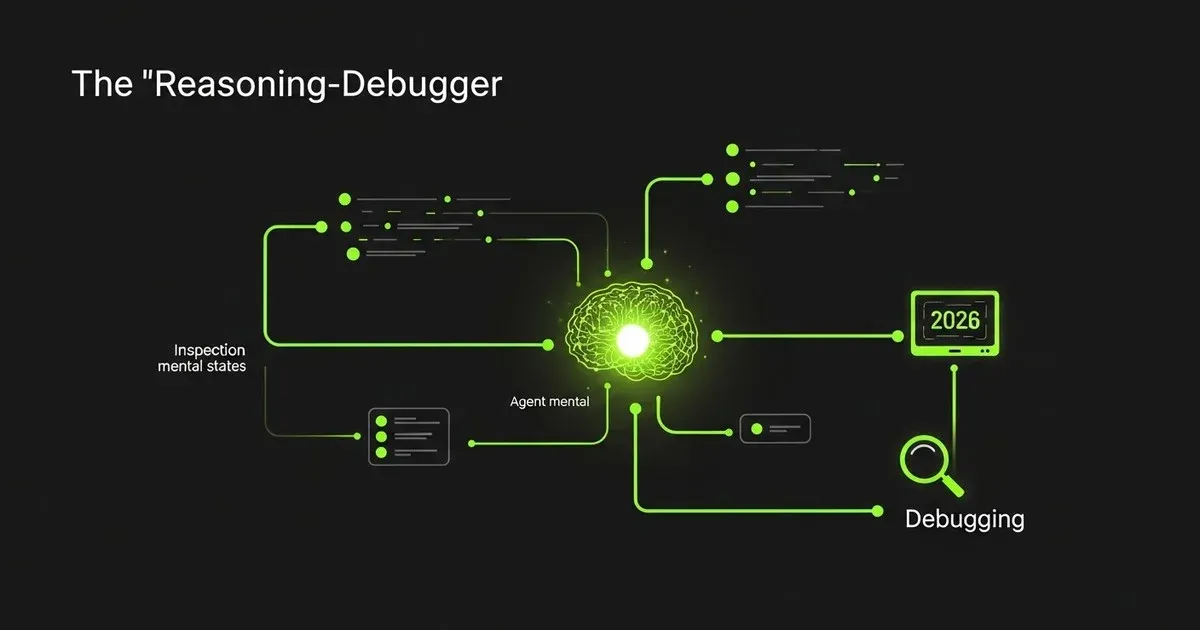
To solve this, we designed the Reasoning-Debugger. Instead of trapping syscalls or instruction boundaries, it traps cognitive transitions.
The Reasoning-Debugger operates on a new standard: the Agent Debugging Protocol (ADP). Much like the Language Server Protocol (LSP) unified IDEs, ADP provides a JSON-RPC interface for inspecting, pausing, and stepping through an agent’s internal thought-state.
+------------------+         ADP (JSON-RPC)         +--------------------+
|  IDE / Debugger  | <============================> |  Agent Runtime     |
|  Visualizer UI   |                                |  (Reasoning Loop)  |
+------------------+                                +--------------------+
         |                                                    |
         v                                                    v
  - Set Cognitive Breakpoints                         - Pause before Action
  - Inspect Latent Memory                             - Step through Thought Trace
  - Hot-Swap Intent-State                             - Mutate Prompt-Context
Key Cognitive Breakpoint Types:
- OnPlanMutation: Pauses execution whenever the agent modifies its hierarchical task list.
- OnValidationFailure: Traps execution if a supervisor agent rejects a proposed reasoning branch.
- OnHighUncertainty: Triggers a breakpoint if the LLM’s token-level entropy exceeds a specified confidence threshold.
- BeforeExternalAction: Forces a human-in-the-loop (HITL) approval step before any database write, API call, or financial transaction.
Practical Example: Stepping Through Cognitive Loops
Let us build a lightweight, production-grade Reasoning-Debugger in Python. This implementation registers a debugging server that wraps our agent’s planning loop, letting us pause and inspect the agent’s intent-state before it commits a destructive action.
import json
import socket
from typing import Dict, Any, List

class CognitiveBreakpoint(Exception):
    """Raised when a cognitive breakpoint is triggered."""
    pass

class ReasoningDebugger:
    def __init__(self, host: str = "127.0.0.1", port: int = 9229):
        self.host = host
        self.port = port
        self.breakpoints: Set[str] = set()
        self.paused = False
        self.client_conn = None

    def enable_breakpoint(self, event_type: str):
        self.breakpoints.add(event_type)

    def start_listener(self):
        """Starts a background server for the ADP client."""
        self.server = socket.socket(socket.AF_INET, socket.SOCK_STREAM)
        self.server.setsockopt(socket.SOL_SOCKET, socket.SO_REUSEADDR, 1)
        self.server.bind((self.host, self.port))
        self.server.listen(1)
        print(f"[ADP] Reasoning-Debugger listening on {self.host}:{self.port}...")

    def check_breakpoint(self, event_type: str, context: Dict[str, Any]):
        """Evaluates whether to pause agent execution."""
        if event_type not in self.breakpoints:
            return

        print(f"\n[TRAP] Cognitive breakpoint triggered: {event_type}")
        self.paused = True
        self._wait_for_debugger(event_type, context)

    def _wait_for_debugger(self, event_type: str, context: Dict[str, Any]):
        if not self.client_conn:
            print("[ADP] Waiting for debugger client connection...")
            self.client_conn, _ = self.server.accept()
            print("[ADP] Debugger client connected.")

        # Send current mental state to the visualizer
        payload = {
            "status": "PAUSED",
            "event": event_type,
            "mental_state": context
        }
        self.client_conn.sendall(json.dumps(payload).encode() + b"\n")

        # Command-loop from developer/visualizer
        while self.paused:
            data = self.client_conn.recv(1024).decode().strip()
            if not data:
                break

            command = json.loads(data)
            cmd_type = command.get("type")

            if cmd_type == "INSPECT":
                # Returns current intent, context, and plan
                response = {"status": "OK", "data": context}
                self.client_conn.sendall(json.dumps(response).encode() + b"\n")
            elif cmd_type == "HOTSWAP":
                # Mutate the agent's mental state at runtime!
                new_intent = command.get("intent")
                context["intent"] = new_intent
                print(f"[ADP] HOT-SWAPPED Agent Intent to: '{new_intent}'")
                response = {"status": "OK", "message": "State mutated"}
                self.client_conn.sendall(json.dumps(response).encode() + b"\n")
            elif cmd_type == "CONTINUE":
                self.paused = False
                print("[ADP] Resuming agent execution loop.")
                response = {"status": "OK", "message": "Resumed"}
                self.client_conn.sendall(json.dumps(response).encode() + b"\n")
Now, let us integrate this into a live reasoning loop. If the agent’s planner tries to rewrite a database schema (an external action), the breakpoint is hit, the thought-state is sent to the developer’s terminal, and the developer can hot-swap the agent’s intent-state to avoid corrupting the system.
# Initialize Debugger
dbg = ReasoningDebugger()
dbg.enable_breakpoint("BeforeExternalAction")
dbg.start_listener()

# Simulating our Agent's Thought State
agent_context = {
    "goal": "Optimize query performance for billing table",
    "intent": "Drop the composite index 'idx_billing_user' to speed up raw writes",
    "risk_level": "CRITICAL",
    "tools": ["drop_index", "create_index"]
}

print("Agent is reasoning about the database optimization...")
# Evaluate cognitive checkpoint
dbg.check_breakpoint("BeforeExternalAction", agent_context)

# Execution proceeds using the potentially mutated intent
print(f"Agent executing action with intent: '{agent_context['intent']}'")
“If you cannot pause a running thought-state, you are not debugging AI; you are merely watching it hallucinate in high definition.”
My Experience: A Live Hot-Swap in Production
Just last month, I was supervising an agentic migration suite tasked with transferring 4.2 million user records across PostgreSQL shards. We had a cognitive breakpoint set on OnPlanMutation with risk filters configured for schema modification.
About 12 minutes in, the migration agent ran into a batch of legacy records with malformed email fields. Instead of failing gracefully, the agent decided that the best way to maintain constraint consistency was to modify the table schema to make the email column nullable.
The debugger immediately trapped the process. The console showed the agent’s planned action, and the latent thoughttrace showed its internal logic: "Making email nullable resolves the shard-transfer blocker while keeping 100% of rows."
Using our ADP client, I issued a HOTSWAP command, modifying the agent’s goal vector to: "Isolate and log malformed rows to a dead-letter queue; under no circumstances alter database constraints."
I hit CONTINUE. The agent paused, re-evaluated its constraint validation parameters against the new intent-state, and smoothly routed the bad records into our dead-letter table without a single byte of schema degradation.
Pros and Cons of Active Cognitive Debugging
Pros
- Destruction Avoidance: Pausing reasoning loops before critical actions prevents costly runtime disasters.
- Explainable AI at Runtime: Developers can see the direct correlation between input prompt context, intermediate thoughts, and tool invocation.
- Context Injection: Allows hot-patching an agent’s memory to guide it away from logical deadlocks without restarting the reasoning cycle.
Cons
- Latency Overhead: Maintaining TCP sockets for active debugging listeners adds minor latency to high-speed loops.
- Inference Resumption Costs: When resuming from a breakpoint, re-injecting a modified thought-state requires a context-window refresh, which can trigger additional token usage.
When to Use This Pattern
You should build an ADP-compliant Reasoning-Debugger when:
- Your agents have access to destructive tools (e.g., file systems, cloud infrastructure APIs, database schemas).
- You are running long-duration agentic workflows where restarting the process from scratch would cost hundreds of dollars in API compute.
- You have a hierarchical multi-agent team where sub-agents frequently drift from the primary supervisor’s intent.
Do not use this pattern for:
- One-shot, simple classification tasks (such as sentiment analysis).
- Low-latency, real-time streaming agents where sub-second response times are the only concern.
Common Mistakes
1. Hardcoding Code Line Breakpoints
Many developers try to attach standard debugger tools (pdb, lldb) to their agentic framework’s Python runner. All this does is pause the execution inside the standard library or core framework orchestrator. You will see generic event-loop code, not your agent’s thinking. Always set breakpoints on the cognitive orchestration hooks instead.
2. Ignoring Prompt Context Injection State
If you hot-swap the agent’s intent but fail to clear its short-term memory buffer, the agent will still behave erratically. When writing debugger mutations, make sure your tool clears the immediate history of the failing thought-path to prevent cognitive dissonance.
Next Steps: Moving Toward Self-Debugging Swarms
If you want to bring cognitive observability to your local stack, here is your path forward:
- Implement ADP Hooks: Instrument your agent runtime’s planner with basic
pre_actionandpost_reasoninghook listeners. - Standardize Thought Logs: Export thought traces using structured JSON, rather than raw strings, to allow visualizer tools to parse them seamlessly.
- Try the Visualizer: Connect your runtime to an open-source visualizer to watch reasoning graphs assemble in real-time.
Debugging in the age of agentic software requires a fundamental shift in our mental model. Once we stop tracing lines of code and start tracing vectors of intent, we can finally build autonomous systems we can actually trust in production.
What cognitive breakpoints are you setting on your agents today? Let us know on Twitter @BitTalks.
Comments
Join the discussion — requires GitHub login