Key Takeaways
- 01 The 'perfect prompt' is dead; we now focus on 'orchestration protocols' for autonomous teams.
- 02 Multi-agent systems (MAS) achieve 10x speed by parallelizing reasoning across specialized context windows.
- 03 Verifiable execution loops are replacing 'vibes-based' AI outputs with auditable, tool-driven results.
- 04 Engineers in 2026 are shifting from 'code writers' to 'architects of reasoning loops'.
Remember when we used to spend hours “jailbreaking” or “perfecting” a single prompt? It feels like ages ago, but that was just 2024. Back then, we treated LLMs like high-powered search boxes. If the answer was wrong, we blamed the prompt.
Fast forward to mid-2026, and the game has fundamentally changed. We aren’t “prompting” anymore. We’re orchestrating.
The Death of the Monolith
The biggest realization of the last eighteen months is that a single model—no matter how many trillions of parameters it has—is a bottleneck. It’s a monolith. When you ask a single model to “write a full-stack app with auth and billing,” you’re forcing it to be a product manager, a security expert, a frontend dev, and a QA engineer all at once. It might do a decent job, but it’ll eventually hallucinate under the weight of its own context.
In 2026, we’ve moved to hierarchical orchestration.
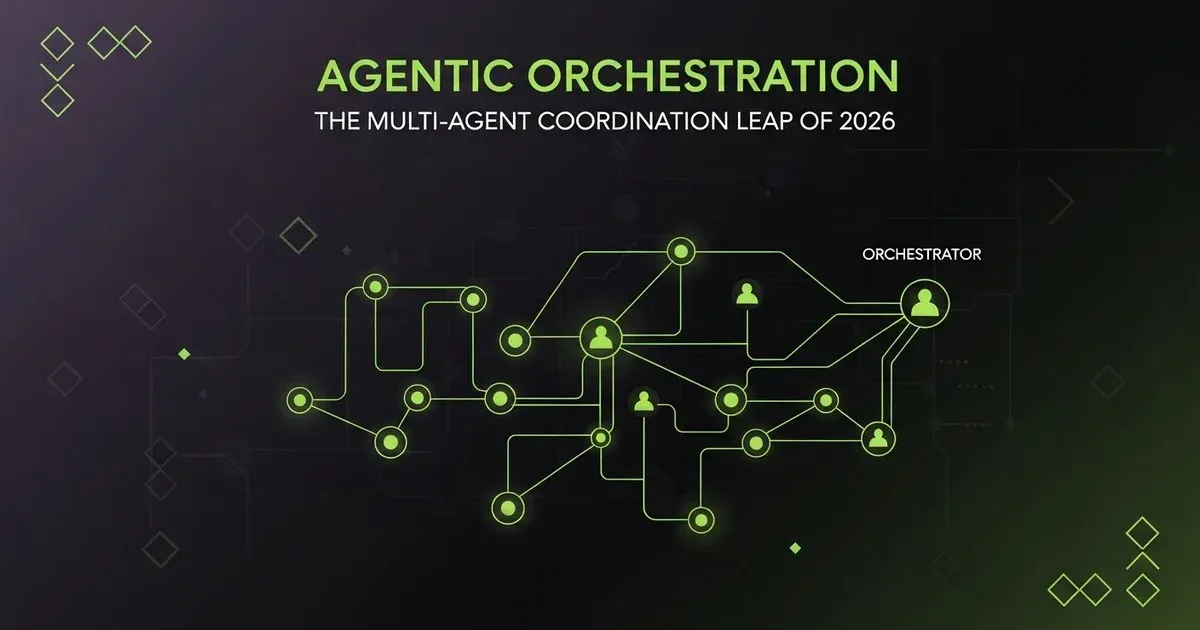
Instead of one massive prompt, we use a central ‘Orchestrator’ agent whose only job is to decompose the objective into tasks and assign them to specialized ‘Worker’ agents (Code-Gen, Security-Audit, Documentation-Expert).
Coordination Protocols: The Language of Agents
The real breakthrough wasn’t just having more agents; it was getting them to talk to each other without us in the middle. We’ve moved beyond natural language “chat” into structured coordination protocols.
Agents now negotiate resources, request peer reviews, and even “hire” other specialized agents through standardized APIs. If the Code-Gen agent hits a roadblock, it doesn’t wait for you. It pings the Research agent for the latest documentation on a niche library, receives a summarized JSON response, and continues.
“Multi-agent systems replace single-agent workflows because they maximize performance gains through parallel reasoning. It’s the difference between one person trying to build a house and a coordinated crew of specialized contractors.”
From “Vibe-Check” to Verifiable Execution
Back in the day, we used to “vibe-check” AI code. We’d look at it, it looked right, and we’d hope for the best.
In 2026, that’s professional malpractice. Modern orchestration loops are built on Verifiable Execution. Every agent action is tied to a tool output—a successful test run, a passing lint check, or a verified database query. If the verification fails, the orchestrator automatically triggers a “Reasoning Audit” to find the flaw in the logic.
Enterprises are now staffing fulfillment centers in 72 hours instead of weeks by using hierarchical orchestration to manage candidate screening, document generation, and sentiment analysis in parallel.
The New Job Description
So, where does that leave us?
I’ll be honest: if your value was “typing speed,” 2026 is a scary year. But if your value is “architectural taste,” it’s the best time to be alive. Our job has shifted from writing the implementation details to designing the reasoning loops that agents follow. We are the directors of the orchestra, ensuring the violins (Code-Gen) and the cellos (Security) are playing from the same sheet music.
Here’s the thing: the “perfect prompt” was always a myth. The perfect system is what matters.
What’s Next?
If you’re still working in a single-chat window, you’re living in the past. It’s time to start thinking in terms of autonomous loops.
- Experiment with hierarchical task decomposition.
- Implement verifiable checkpoints in your agentic workflows.
- Stop writing code; start designing the reasoning that writes the code.
The leap from 2025 to 2026 wasn’t about bigger models. It was about better coordination. Welcome to the era of the Orchestrator.
Comments
Join the discussion — requires GitHub login