Key Takeaways
- 01 The era of 'vibe-based' prompting is over; structured specifications are the new standard.
- 02 Specification-Driven Development (SDD) uses machine-readable artifacts to coordinate human-agent collaboration.
- 03 GitHub's Spec Kit has become the industry standard for defining agentic guardrails and non-goals.
- 04 Transitioning to SDD reduces coordination costs and eliminates the 'almost right but not quite' frustration of raw LLM outputs.
Remember the “Prompt Engineer” hype of 2023? It feels like ancient history now. Back then, we were all trying to find the magic sequence of words—the “open sesame”—that would make an LLM spit out a working React component. We spent hours refining “mega-prompts,” hoping the model wouldn’t hallucinate the state management logic.
Fast forward to 2026, and the industry has collectively moved on. We’re not “prompting” anymore. We’re specifying.
The shift to Specification-Driven Development (SDD) is the single most significant change in how we build software since the adoption of Git. It’s the difference between shouting directions at a driver and giving them a high-definition GPS coordinate with a pre-mapped route.
The Problem with “Prompting”
The issue with traditional prompting was never the models; it was the interface. Natural language is beautiful for poetry, but it’s dangerously ambiguous for engineering. When you “prompt” an agent, you’re relying on its ability to infer intent from a stream of consciousness.
A 2025 study found that while developers used AI in 60% of their workflow, they could only “fully delegate” about 15% of tasks. The reason? “Vibe-based” prompting led to results that were “almost right but not quite,” requiring more time to fix than to write from scratch.
In 2026, we don’t have time for “almost right.” We need deterministic outcomes from autonomous systems.
What is Specification-Driven Development?
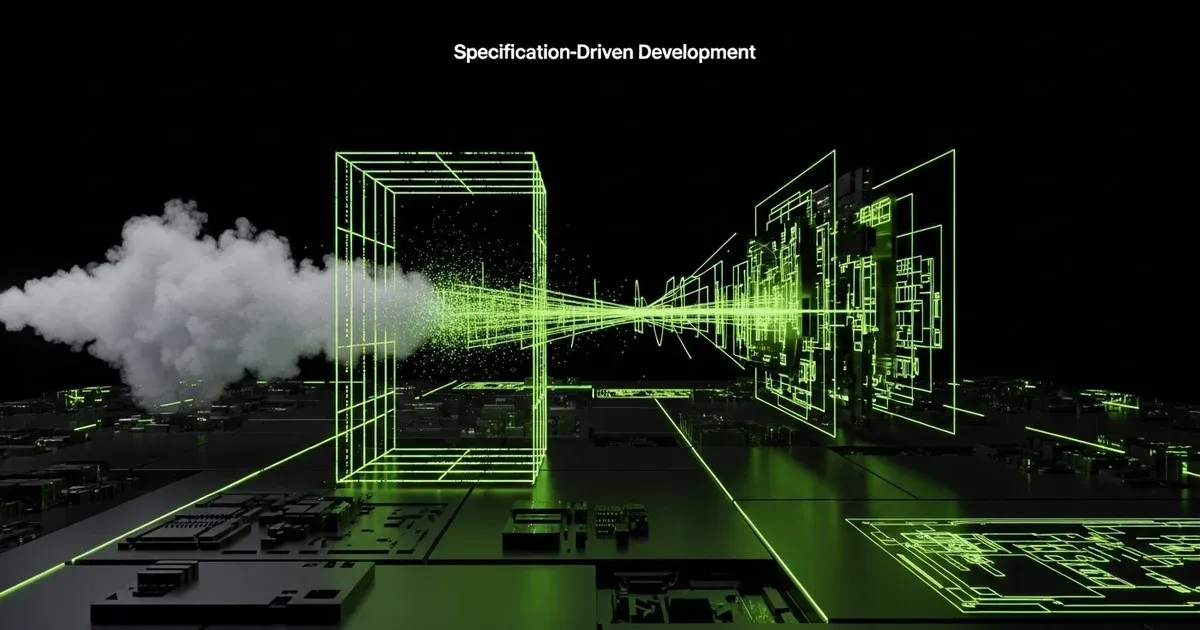
SDD is a methodology where intent is captured early in structured, machine-readable forms—Specifications—that agents can act on directly. Instead of a chat window, the primary interface between a human and an agent is a Spec File.
These specs aren’t just Jira tickets; they are living artifacts that define:
- Explicit Invariants: What must never change.
- Acceptance Criteria: Quantifiable goals.
- Non-Goals: Explicit boundaries to prevent scope creep.
- Safety Checks: Guardrails for destructive actions.
“SDD didn’t just make our agents faster; it made them reviewable. I can’t code-review a 2,000-word prompt, but I can certainly review a structured specification for architectural soundness.”
The GitHub Spec Kit Revolution
The turning point came when GitHub open-sourced its Spec Kit. It provided a standardized schema for these requirements, allowing different agents from different vendors to work off the same “source of truth.”
When I start a new feature today, I don’t “chat” with an agent. I draft a .spec.md file. My agent then parses this, identifies ambiguities, and asks for clarification before writing a single line of code.
A Typical 2026 Workflow
- Human drafts the Spec: I define the high-level intent, data contracts, and edge cases in a structured markdown format.
- Agent analyzes the Spec: The agent checks for logical inconsistencies or missing context (e.g., “You didn’t specify the retry policy for the payment gateway”).
- The “Handshake”: Once the spec is validated, the agent generates an implementation plan.
- Autonomous Execution: The agent executes the plan, using the spec as a continuous guardrail.
# Spec: User Authentication Mesh
## Invariants
- All passwords must be hashed using Argon2id.
- JWT expiration must not exceed 15 minutes.
## Non-Goals
- We are NOT implementing OAuth2 in this sprint.
## Acceptance Criteria
- [ ] 100% test coverage on the auth middleware.
- [ ] Integration test passes on the /login endpoint.
Why This Matters Now
As we scale toward the 1,000-agent engineering team, coordination cost is the ultimate bottleneck. You can’t manage a swarm of agents through chat. You need a protocol.
SDD is that protocol. It’s how we ensure that the “Agentic SDLC” doesn’t turn into an “Agentic Mess.” By shifting from prompt-led conversations to artifact-led execution, we’ve finally bridged the gap between “AI as a toy” and “AI as a teammate.”
My Take: The Death of the “Black Box”
The most refreshing part of the SDD era is the transparency. When an agent fails (and they still do, occasionally), I don’t have to wonder why. I can look at the spec and see exactly which invariant was violated or which non-goal was ignored.
We’ve moved from debugging “vibes” to debugging logic. And honestly? I don’t miss the prompts at all.
This shift mirrors what we saw earlier this year with the Planning-First Revolution, where developers began ditching raw prompting for agentic architectures. If you’re interested in how this affects team dynamics, I highly recommend my previous deep dive into the Oversight Scaling Crisis.
If you’re still relying on raw chat interfaces for your agentic workflows, it’s time to start drafting your first Spec Kit. Your future self (and your agents) will thank you.
Comments
Join the discussion — requires GitHub login