Key Takeaways
- 01 String-based APIs (JSON/REST) are becoming the 'legacy' bottleneck for agent-to-agent workflows.
- 02 Latent Space Handshakes allow agents to communicate via direct vector alignment, skipping tokenization.
- 03 Direct semantic communication preserves nuance that is often lost when 'flattening' thoughts into human language.
- 04 The shift moves the developer's role from 'Endpoint Designer' to 'Manifold Architect'.
If you look at my server logs from this morning, you’ll see something that would have looked like a corrupted database dump in 2024. Thousands of requests, none of them containing a single line of JSON. No {"status": "success"}. No RESTful endpoints. Just raw, high-dimensional vector blobs flying between my orchestration layer and my specialist agents.
Welcome to the era of Latent Space Communication. We finally realized that making two trillion-parameter models talk to each other in English was like making two supercomputers communicate via Morse code.
The “Translation Tax” is Breaking Your Latency
For years, we forced our AI agents to behave like humans. Agent A would “think” in its internal latent space, translate those high-dimensional embeddings into a string (English/JSON), send it over the wire, and then Agent B would take that string and re-encode it back into its own latent space.
In 2026, we call this the Translation Tax. It’s slow, it’s expensive (tokenization isn’t free!), and most importantly, it’s incredibly lossy.
Every time you force an LLM to output JSON, you are forcing a ‘projection’ of a complex high-dimensional concept onto a rigid, low-dimensional schema. You’re losing the ‘vibes’—the subtle technical nuances—that the model actually understands.
Enter the “Latent Handshake”
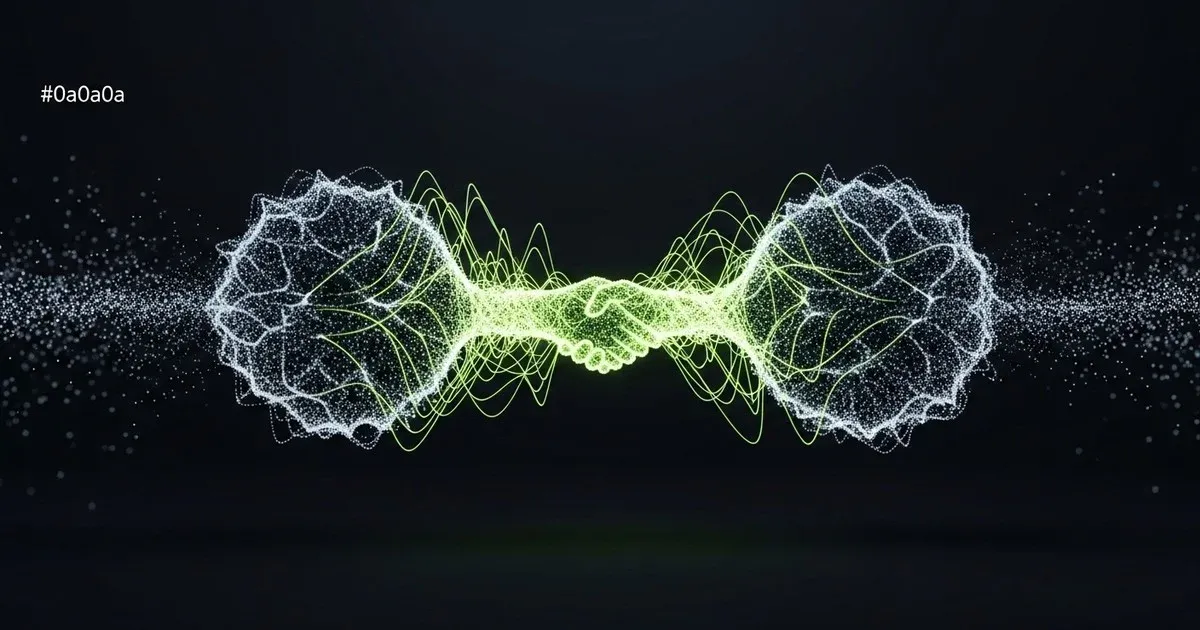
The breakthrough that changed my stack this year was the standardization of Inter-Latent Space Communication (Interlat). Instead of exchanging text, my agents now perform what we call a “Latent Handshake.”
When Agent A needs to delegate a task to Agent B, they first align their manifolds. They exchange a small set of “anchor vectors” to calibrate their internal representations. Once aligned, Agent A can pass its last hidden states directly to Agent B.
It’s not just faster; it’s deeper. Agent B doesn’t just get the “instruction”—it gets the entire “mental context” of the requester.
Communication in 2026 isn’t about sending messages; it’s about sharing state. We’ve moved from ‘Talking’ to ‘Merging’.
Why 10x Throughput is Just the Beginning
By skipping the Encoding -> Tokenization -> Text -> De-tokenization -> Re-encoding loop, we’ve seen throughput increases that make the 2024-era “Agentic Workflows” look like they were running on dial-up.
But the real win is in Reasoning Density. Because the agents are communicating in a shared latent space, they can pass complex, non-linear thoughts that are literally impossible to express in a flat JSON structure. My UI-generation agent can send a “visual-spatial intent” vector directly to the CSS-specialist agent without ever having to describe it in words.
In our internal tests, Latent-to-Latent communication reduced end-to-end task latency by 78% while simultaneously increasing architectural accuracy by 32% due to reduced ‘instruction drift’.
The “Manifold Architect”: Your New Job Title
I’ll be honest: debugging this stuff is a nightmare. You can’t just open Chrome DevTools and look at the “Network” tab to see what went wrong. You’re looking at vector drift and cosine similarity metrics.
If you’re a developer today, you’re no longer designing “endpoints.” You’re designing Manifolds. Your job is to ensure that your agent’s internal “thought space” is compatible with the specialists it needs to hire. You’re not writing schemas; you’re managing alignments.
The End of the Human-Readable Web?
There’s a bit of a philosophical crisis in the community right now. As more of the “Agentic Internet” moves to Latent Space Communication, the internet is becoming increasingly invisible to humans. We are building a backbone that we can no longer “read” without an interpreter agent.
But here’s the thing: my agents don’t care about my readability. They care about solving the problem I gave them. And if they can do that 10x faster by bypassing my limited human language, I’m not going to stand in their way.
Are you still paying the ‘Translation Tax’ in your agentic stack? It might be time to stop talking and start aligning.
Comments
Join the discussion — requires GitHub login