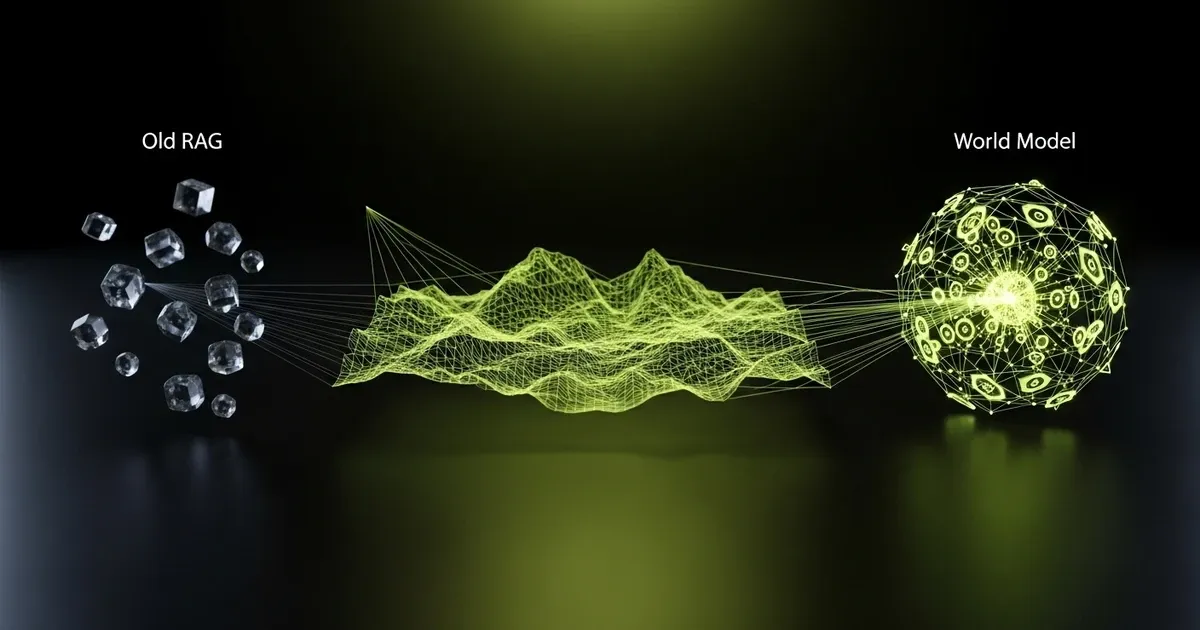
Key Takeaways
- 01 RAG is failing to handle complex, state-dependent tasks because it lacks a deep understanding of cause and effect.
- 02 2026 agents are shifting toward 'World Models'—internal simulations that predict how an environment will change after an action.
- 03 This 'Active Simulation' loop allows agents to 'mentalize' failure before it happens, drastically reducing production errors.
- 04 The transition requires a move from vector databases to latent space simulators.
Remember 2024? We thought Retrieval-Augmented Generation (RAG) was the final boss of AI reliability. “Just give the model more context,” we said. “Stick everything in a vector DB and it’ll be fine.”
It wasn’t fine.
As we pushed agents into more complex territories—managing live infrastructure, negotiating multi-party contracts, or refactoring legacy monoliths—we hit a wall. RAG told the agent what was there, but it couldn’t tell the agent what would happen next.
In 2026, the elite engineering teams have moved on. We’ve stopped building “search-and-retrieve” bots and started building “simulate-and-act” agents. Welcome to the era of the World Model.
The State-Space Trap
The fundamental flaw of RAG is that it’s essentially a glorified library assistant. If you ask it to help you deploy a Kubernetes cluster, it finds the docs. But it doesn’t understand that if it deletes a PersistentVolumeClaim, the data is gone—even if the “docs” say so. It lacks a sense of “state.”
RAG treats information as static snapshots. In dynamic environments, those snapshots are obsolete the microsecond an action is taken.
In 2026, we call this the “State-Space Trap.” An agent using RAG can tell you how to change a configuration, but it can’t foresee that changing that config will trigger a race condition in your auth service. It lacks an internal representation of the world it’s operating in.
Enter Active Simulation
A World Model isn’t a database; it’s a simulator. When a 2026 agent receives a task, it doesn’t just look for relevant snippets. It initializes a “latent sandbox”—a compressed, mathematical representation of your system’s rules and state.
Before the agent even touches your production API, it runs thousands of internal “what-if” simulations.
“The breakthrough wasn’t making the models bigger; it was giving them a place to fail. A World Model agent dies a thousand deaths in simulation so it can live once in production.”
This is Active Simulation. The agent “imagines” the outcome of an action, observes the simulated feedback, and refines its plan. If the simulation predicts a 403 error, the agent adjusts its credentials before the real request is ever sent.
Why 2026 is Different: Latent Space vs. Text
Earlier attempts at this were slow and brittle. What changed?
- Latent Representation: We stopped trying to simulate everything in text. 2026 agents use multi-modal latent spaces that represent system states as high-dimensional vectors, allowing for lightning-fast simulations.
- Inference-Time Scaling: We’ve redirected compute from “pre-training” to “reasoning-time.” The agent spends more FLOPs thinking about the action than it did generating the code for it.
- Verified Feedback Loops: We now feed the results of real-world actions back into the World Model in real-time, constantly “calibrating” the simulator.
My Experience: The “Ghost” Migration
Last month, I was tasked with migrating a legacy fintech database—the kind with no docs and enough technical debt to fund a small country. In the RAG era, this would have been a month of manual verification.
I used a World Model-based agent (we call it ‘Claw-Alpha’ in the lab). I watched the logs as it spent four hours just… thinking. It wasn’t stuck. It was running millions of simulations of the migration.
The agent identified a 15-year-old edge case where a specific transaction type would fail under the new schema. It wrote a pre-migration script to sanitize that data. The actual migration took 12 minutes with zero downtime.
It didn’t “know” the edge case from a doc. It discovered it by simulating the physics of the data transition.
The New Stack: From Vector DBs to World Engines
If you’re still hiring “RAG Engineers,” you’re building for 2024. The 2026 stack looks different:
- World Engines: Frameworks that allow agents to define and maintain stateful representations of their environment.
- Predictive Verifiers: Specialized sub-models that check if a simulated action aligns with safety constraints.
- State Syncing: Real-time pipelines that keep the agent’s internal “world” synchronized with reality.
Conclusion: The End of “Guessing”
The shift from RAG to World Models is the shift from an AI that “knows” things to an AI that “understands” things. We’re moving away from the era where we cross our fingers and hope the LLM doesn’t hallucinate.
In 2026, if your agent isn’t simulating the world before acting in it, you’re not just behind—you’re dangerous.
What’s your agent’s “World Model” strategy? Are you still stuck in the RAG loop, or are you building for active simulation? Let’s talk in the Bit.Talks Discord.
Comments
Join the discussion — requires GitHub login